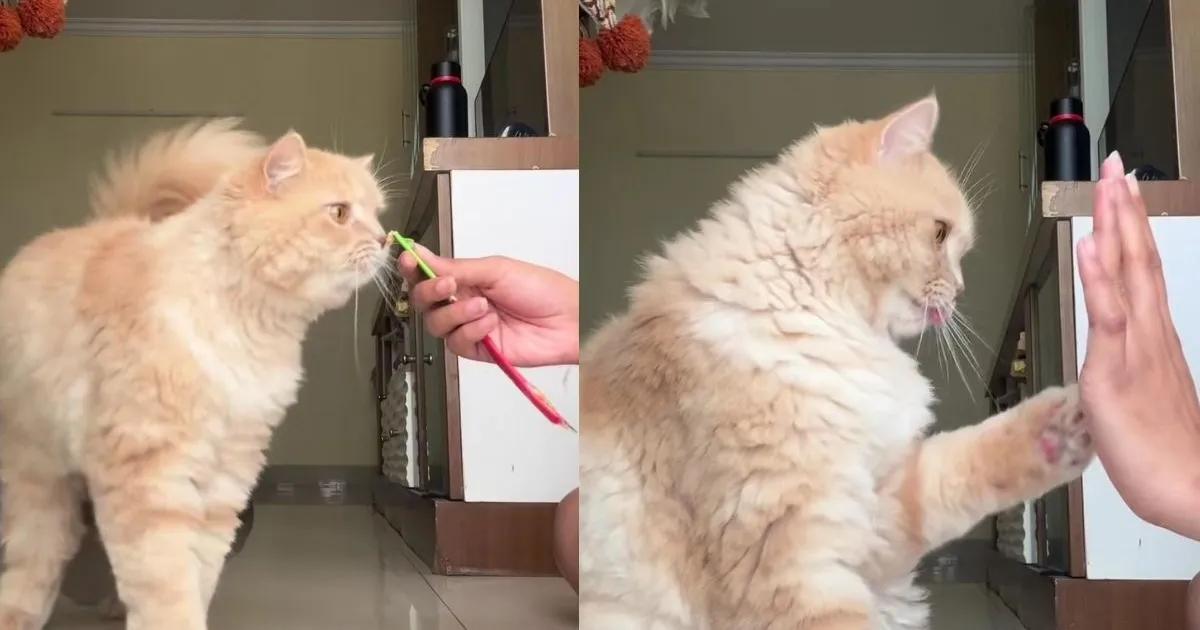
# Cat Owner Proves Felines Learn Dog Tricks Just as Well
Doobie, an orange cat whose owner posts training videos under the handle @doobsterooni, now performs five commands typically associated with dogs. The cat demonstrates sit, paw offering, high five, standing upright on hind legs, and a fifth trick in rapid succession during training sessions. A single squeeze-up treat serves as the reward that keeps Doobie focused and motivated throughout each session.
This training achievement challenges a common misconception about cats. Many pet owners assume dogs possess a natural advantage in learning obedience commands, but Doobie's performance reveals the truth. Cats learn through the same behavioral principles that work with dogs: positive reinforcement, consistency, and food motivation.
Cat training works when owners understand feline psychology. Cats respond to immediate rewards and clear communication. Unlike dogs, cats need shorter training sessions, typically five to ten minutes. They lose focus faster and require higher-value treats to stay engaged. Squeeze-up treats like those Doobie receives work well because cats consume them quickly and return to the next command without delay.
The sit command forms the foundation for cat training. Most cats already sit naturally, so shaping this behavior into a reliable response to a verbal cue or hand signal takes minimal effort. Offering a paw follows sit logically. Cats paw at objects and people regularly. Trainers capture this natural behavior and attach a command to it, rewarding each repetition.
High fives require slightly more effort. Trainers hold a treat near the cat's chest and slightly above the head, encouraging the cat to reach upward with a front paw. When the paw contacts the trainer's hand, the treat arrives immediately. Repetition teaches the cat that this specific paw movement triggers the reward.
Standing upright on hind legs represents a more advanced trick. It builds on the high five foundation. Trainers hold the treat higher, requiring the cat to stretch further and balance briefly on back legs. This trick demands physical fitness, so cats under two years old learn it most easily. Older cats may achieve it with patient, consistent training.
Doobie's training success demonstrates that cat owners underutilize their pets' learning capacity. Cats possess problem-solving skills, memory, and the ability to form associations between actions and outcomes. A 2022 study published in the journal "Applied Animal Behaviour Science" found cats respond to training with positive reinforcement as readily as dogs do.
The key difference lies in motivation style. Dogs often work for social approval and praise. Cats work primarily for food rewards and rarely prioritize pleasing their owners. Training cats requires accepting this reality and using high-value treats consistently.
Pet owners interested in teaching their cats tricks should start with one simple command, train in quiet environments, keep sessions short, and reward immediately after each successful performance. Consistency matters more than frequency. Three five-minute sessions weekly beats one lengthy session.
Doobie's accomplishments prove that "dog tricks" belong exclusively to dogs only in the minds of owners who haven't tried teaching their cats. The potential exists in most cats. It simply requires the right approach, proper motivation, and realistic expectations about feline behavior.