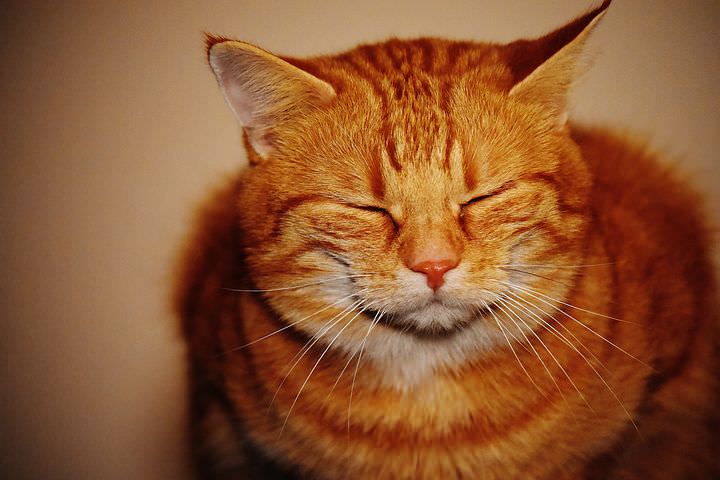
# Why Your Tabby Cat Has That Distinctive "M" on Her Forehead
That prominent "M" marking on your tabby cat's forehead isn't random. It's the result of specific genetics that shape how pigment distributes across her face, and it appears in nearly all tabby cats regardless of their particular pattern variation.
The mark comes from the tabby gene's agouti pathway. Agouti refers to the banding of color on individual hair shafts. In tabby cats, this genetic pathway creates stripes, swirls, and spots by controlling where pigment appears. The forehead "M" is simply the most visible expression of this same genetic mechanism on the face.
The agouti gene works by switching pigment production on and off as each hair grows. Light and dark bands result from these alternating periods. When this happens on the forehead, the pattern naturally forms what looks like the letter M. Think of it as the most prominent stripe configuration in that specific facial location.
Most tabby patterns show this mark boldly. Classic tabbies, with their thick circular stripes and swirled patterns, display the M with striking clarity. Mackerel tabbies, which have thin stripes running vertically down the body, show it equally well. Spotted tabbies, featuring discrete spots instead of continuous stripes, also carry the marking. Ticked tabbies, the least striped pattern where only the face and legs show distinct markings, display the M as one of their most recognizable features.
Not every cat with an "M" is a tabby. Some solid-colored cats and other patterns carry faint or barely visible M markings. This occurs because many cats carry recessive tabby genes even when they don't express obvious tabby stripes elsewhere on their body. The forehead remains one of the easiest places to spot these hidden genetic markers.
The marking appears consistent across tabby populations worldwide because it reflects fundamental genetics rather than geography or selective breeding. Feral and domestic tabbies alike display the M with remarkable similarity. Breeders have never had to work to produce it. The trait simply emerges wherever the tabby gene operates.
Your tabby's "M" serves no survival function in modern domestic life, but it connects to the species' wild ancestry. African wildcats, the distant relatives of domestic cats, carry similar markings. Some researchers theorize the pattern may provide subtle facial camouflage or play a role in cat-to-cat communication, though these benefits matter little for indoor pets today.
If you're curious about your specific cat's genetics, DNA testing companies like Basepaws and Embark now offer feline genetic panels. These tests identify not only tabby genes but also other hereditary traits and breed ancestry. Your veterinarian can recommend which tests suit your cat best.
The "M" on your tabby's forehead represents one of nature's most consistent genetic expressions in cats. Every time you notice it, you're looking at generations of genetic instruction playing out in real time on her face.