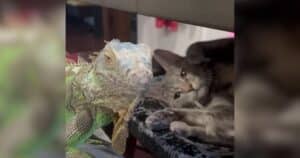
# Cats and Iguanas: An Unlikely Household Dynamic
Introducing an iguana to a home with cats presents unexpected challenges that pet owners should navigate carefully. A recent story highlights how feline curiosity can intensify when a new reptile arrives, requiring thoughtful management to keep both species safe.
Cats possess strong prey drives that iguanas trigger instinctively. The iguana's movement, size, and unfamiliar appearance activate hunting behaviors in even well-socialized cats. Their obsessive interest stems from predatory instincts rather than friendliness. Iguanas, meanwhile, experience extreme stress when constantly watched or stalked by feline housemates.
Pet owners bringing an iguana into a cat household must establish strict separation protocols. Iguanas need secure, enclosed terrariums with basking areas, proper UVB lighting, and temperatures between 75 to 85 degrees Fahrenheit. Cats should never have unsupervised access to the iguana's enclosure.
Stress from constant feline attention weakens an iguana's immune system and reduces appetite, leading to serious health problems. Cats may attempt to open enclosures, knock over tanks, or scratch at barriers. Some cats become so fixated they refuse to leave the iguana's area, pacing and meowing obsessively.
Veterinarians recommend keeping these species in separate rooms when possible. Allow cats to acclimate gradually to the iguana's scent through closed doors before any visual contact. Never allow direct interaction. If cats show sustained hunting behavior, consult with a veterinary behaviorist about management strategies.
Housing an iguana alongside cats demands commitment to their conflicting needs. The iguana's welfare depends on a stress-free environment, while cats require enrichment that doesn't center on the reptile. Pet owners should honestly assess whether their home